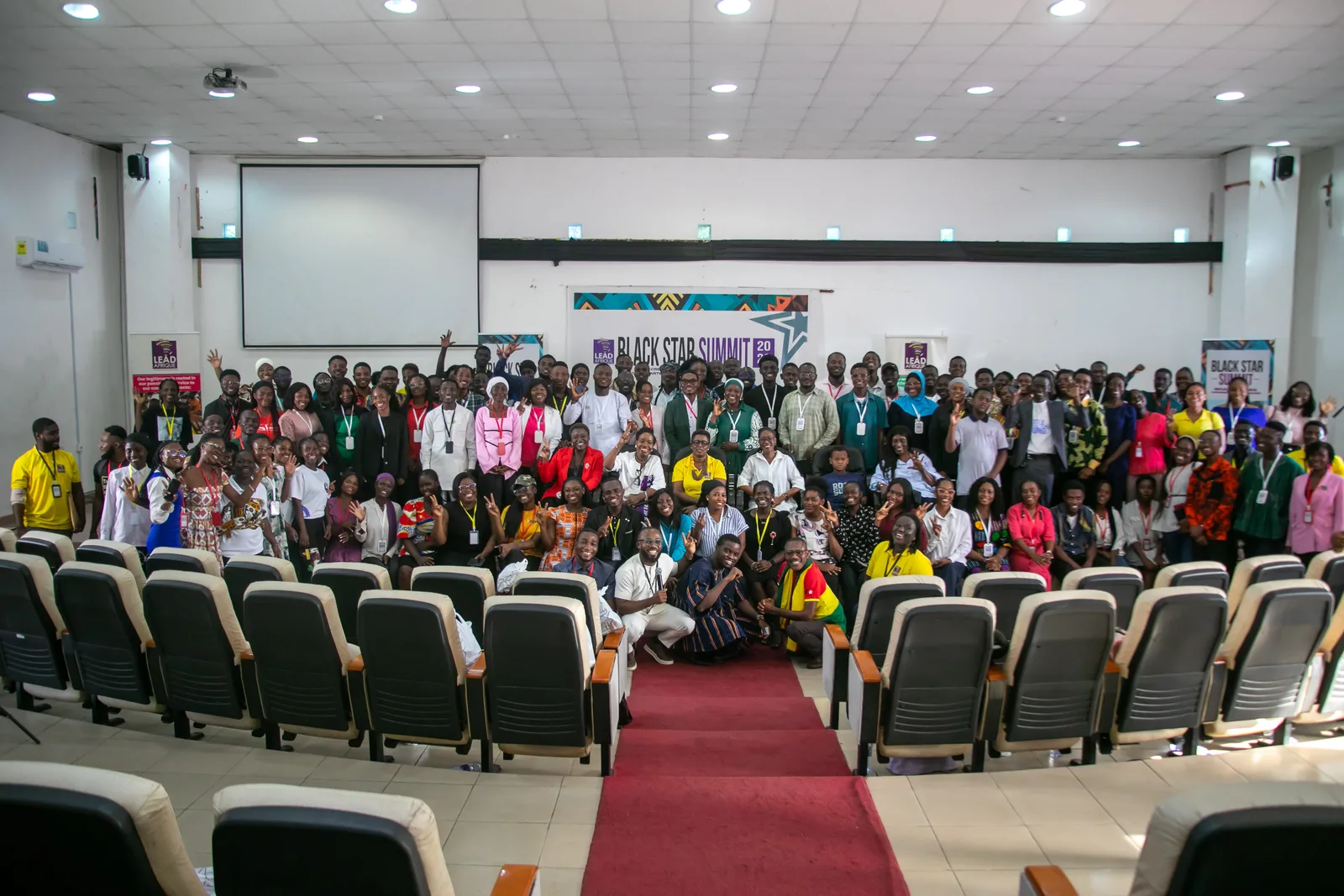
Young Ghanaians who gathered in Accra for the Black Star Summit 2026 delivered a blunt message to the country’s leaders: they are ready to help shape national policy, but they will no longer accept being invited into decision-making spaces only to fill seats. Organised by LeadAfrique International, in partnership with other youth leadership development organisations, this year’s summit is the second.
Held under the theme “Co-Creating the Ghana We Want: Youth Participation, Citizenship and Activism,” the Black Star Summit brought together over 210 young people, student leaders, and civic activists on 1 May 2026 for two keynote addresses, a plenary panel and seven sector breakout sessions spanning Education, Employment, Agriculture and Agribusiness, Technology, the Creative Economy, Health, and Trade and Commerce.
In the opening keynote, Baaba Nhyira Bondzie, President of the Central Leadership Program alumni association, framed nation-building as a shared civic obligation. She challenged the assumption that national development is somebody else’s responsibility and recast activism as everyday integrity, service and accountability rather than protest alone.
A second keynote by Benjamin Akuffo Darko of Democracy Hub pressed participants to convert energy into structure. Mobilisation, he argued, brings people together for a moment, while organisation builds the discipline needed for lasting influence in district assemblies, Parliament and other institutions of state.
The summit’s central tension surfaced in a plenary panel pointedly titled “Beyond Tokenism: Are Ghana’s Youth Shaping Policy or Just Filling Seats?” Panellists observed that although young people make up a large share of Ghana’s electorate, representation on its own rarely translates into authority, voice or measurable policy impact.
Across the sector breakouts, participants moved from diagnosis to concrete proposals. The Education session called for a shift from rote learning to practical, problem-solving skills and for stronger technical and vocational partnerships. The Employment discussion pushed for transparent, merit-based recruitment and for aligning training with the needs of the labour market. Agriculture delegates demanded stronger extension services, district storage facilities and insurance for first-time and youth farmers, while the Technology and Creative Economy groups urged government to decentralise digital, creative and agricultural infrastructure beyond Accra to all sixteen regions. The Health session focused on the strain on the National Health Insurance Scheme, calling for independent and transparent governance, diversified funding, and a stronger emphasis on prevention and primary care.
Several concerns cut across break-out every room. Participants returned repeatedly to the need for a mindset shift from passive observation to active ownership, the widening gap between what schools teach and what the economy demands, the injustice of concentrating opportunity in a handful of cities, and a deep deficit of accountability and transparency in public institutions.
A Black Star Summit report distils these discussions into cross-cutting recommendations for a forthcoming Communique: a public, audited National Youth Participation Dashboard updated quarterly, tracking statutory youth representation quotas at national, regional and district levels, an overhaul of the technical and vocational education system, legislation mandating merit-based recruitment, and legal protection for civic activists.
This is not a wish list. Each of the seven sectors now has a full youth-authored policy document setting out the specifics. See the blueprints here. Organisers stressed that “the Ghana that young people want is not waiting to be discovered. It is waiting to be built”.
The Black Star Summit is a youth-led policy initiative convened by LeadAfrique International, a Ghanaian leadership and youth-development organisation headquartered at GREATness House in Accra.