The recent internal party elections give us an opportunity to ask a question that goes beyond any one political party: Are we deliberately building a political leadership pipeline that gives women a meaningful opportunity to lead?
At LeadAfrique International, through our Empowering Women in Politics (EWIP) programme, we believe this is a question worth asking of every political party in Ghana.
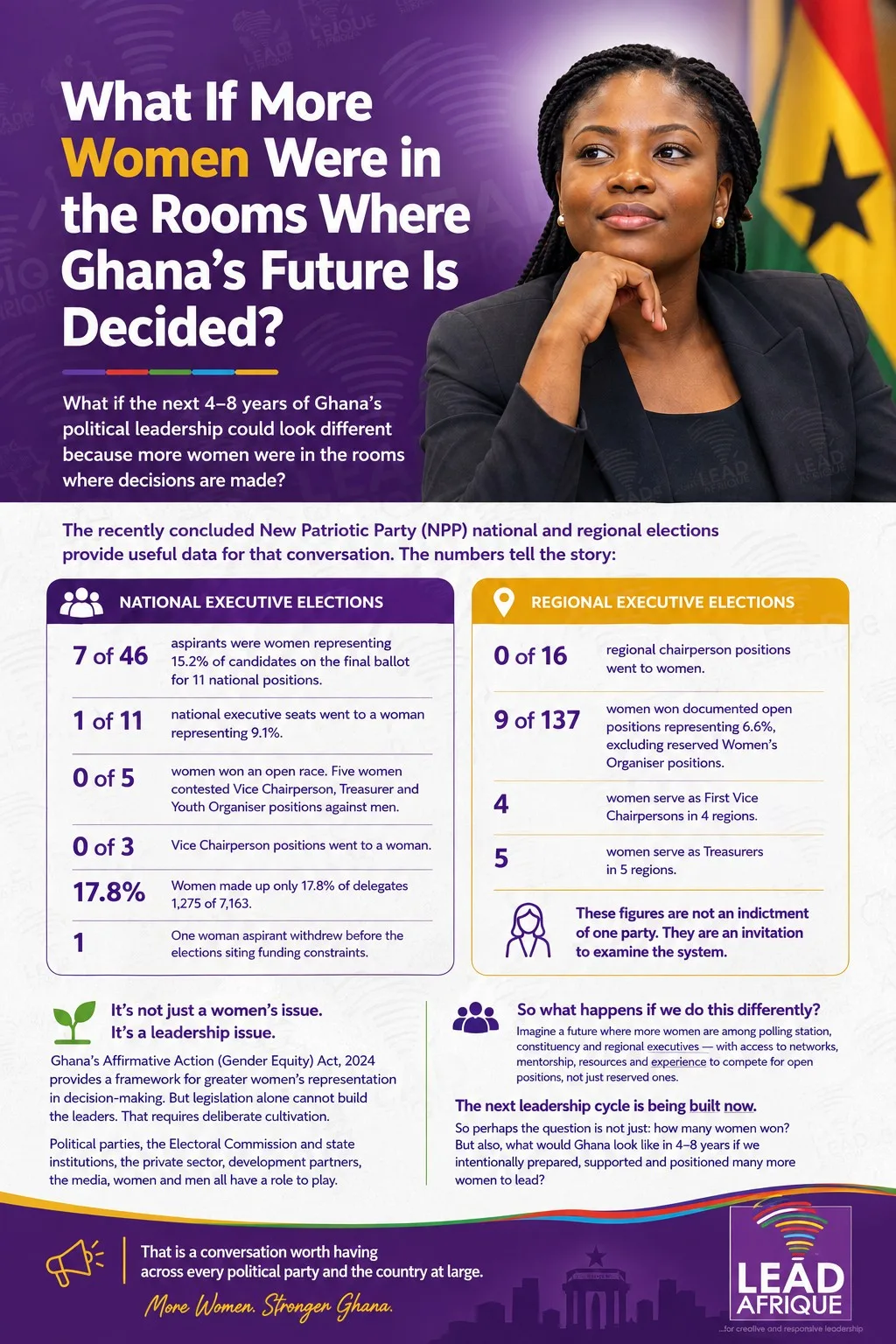
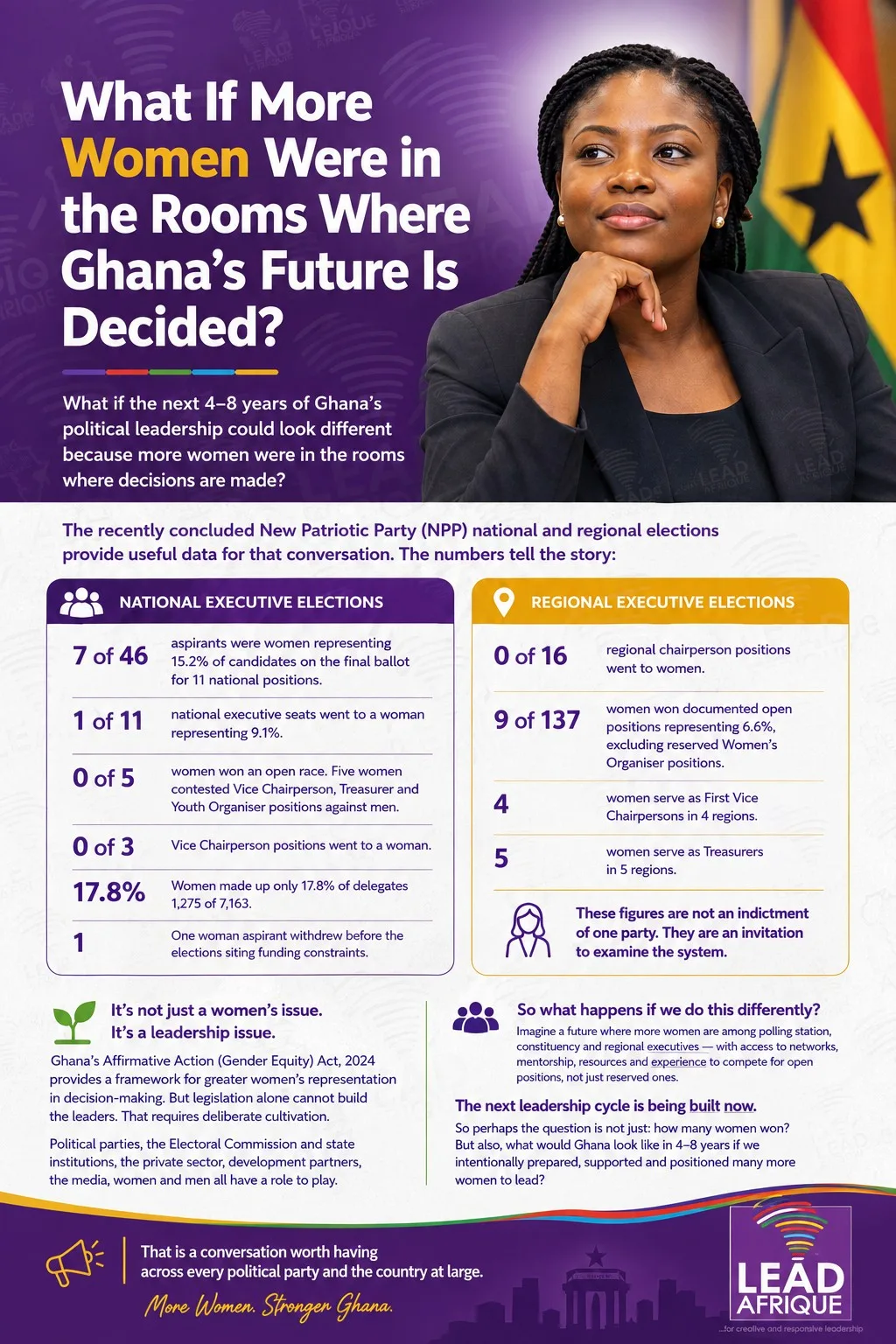
The recently concluded New Patriotic Party (NPP) national and regional elections provide useful data for that conversation. The numbers tell the story as demonstrated below:
NATIONAL EXECUTIVE ELECTIONS
· 7 of 46 aspirants were women, representing 15.2% of candidates on the final ballot for 11 national positions.
· 1 of 11 national executive seats went to a woman representing 9.1%.
· 0 of 5 women won an open race. Five women contested Vice Chairperson, Treasurer, and Youth Organiser positions against men.
· 0 of 3 Vice Chairperson positions went to a woman.
· Women made up only 17.8% of delegates: 1,275 of 7,163.
· One woman aspirant withdrew before the elections, citing funding constraints.
REGIONAL EXECUTIVE ELECTIONS
· 0 of 16 regional chairperson positions went to women.
· Women won 9 of 137 documented open positions representing 6.6%, excluding reserved Women's Organiser positions.
· Yet women now serve as First Vice Chairpersons in 4 regions and Treasurers in 5 regions.
These figures are not an indictment of one party. They are an invitation to examine the system.
Because the question is not whether Ghana has capable women. We do.
Women are contesting. Women are serving. Women are building experience. Women are winning positions and, in some cases, coming remarkably close in highly competitive open contests.
The bigger question is whether we are doing enough to create the pipeline, support and pathways that allow capable women to move from participation to influence.
And this matters because today's regional executive could be tomorrow's national leader. Today's constituency organiser could become tomorrow's party chairperson. Today's young woman learning to lead could become tomorrow's minister, parliamentarian or national decision-maker.
So what happens if we do this differently?
Imagine every political party deliberately developing women leaders from the grassroots upward.
Imagine more women among polling station, constituency and regional executives. Imagine women having access to the networks, mentorship, resources and experience required to compete for open positions, not simply positions reserved for women.
Imagine that, four or eight years from now, we look at Ghana's political leadership and see a significantly stronger representation of women. What might be different? Would different questions be asked? Would different experiences shape policy? Would more girls see political leadership as a realistic possibility? Would our political parties themselves become stronger?
We cannot assume that women will lead differently simply because they are women. But we can acknowledge that when the people making decisions come from a broader range of experiences, the conversation itself can become richer.
This is therefore not simply a women's issue. It is a leadership issue. Ghana's Affirmative Action (Gender Equity) Act, 2024 provides a framework for greater women's representation in decision-making. But legislation alone cannot build the leaders. That requires deliberate cultivation.
Political parties have a role. The Electoral Commission and state institutions have a role. The private sector and development partners have a role. The media has a role. Women have a role. And men have a role.
Through EWIP, we believe we should not wait until the next elections to ask why there are not enough women at the top. The next leadership cycle is being built now. So perhaps the question we should leave ourselves with is not how many women won. But also, what would Ghana look like in 4–8 years if we intentionally prepared, supported, and positioned many more women to lead?
That is a conversation worth having across every political party and the country at large.